図書館報『藤棚ONLINE』
国際言語文化センター ・WANG Marian先生 推薦
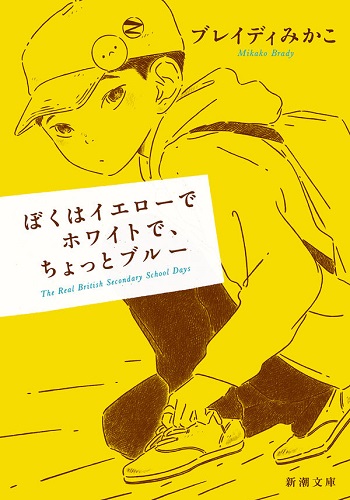
『ぼくはイエローでホワイトで、ちょっとブルー The Real British Secondary School Days』
I was raised in the United States where my ethnic background of being half Japanese and half Taiwanese was never an issue until I was enrolled in a Japanese school on Saturdays when I was about seven or eight years old. At Saturday school, I realized that being “half” Japanese was not to be discussed because all of my classmates were “pure” Japanese and were eager to return to Japan. It may come as no surprise then that my Japanese teacher suggested I change my name to something more Japanese so that I would not be a target of bullying. I did choose a Japanese first and last name, and in hindsight I feel it was the right decision as I blended in quite well. However, this experience of hiding my multicultural background left me confused and wanting to know more about Hafu (half Japanese and half another race) experiences all over the world.
I chose to read this book because I wanted to know how it was for a mother (the author) to raise a half Japanese son in the United Kingdom. The main questions I had before reading the book were: What does it mean to be a Hafu in the United Kingdom? How do you raise a Hafu child in the United Kingdom to make sure he/she has a firm understanding of Japanese culture? As I started to read the book, I realized that the topic of Hafu was not the focus of the book. In the United Kingdom, and particularly where the author was living, there were many races and being half Japanese did not raise red flags. Moreover, the author did not send her son to Japanese school in the United Kingdom, nor did she teach him Japanese, so her son did not appear to have a grasp of written and spoken Japanese. Slightly disappointed that the book would not answer my initial questions, I continued to read the book with the understanding that this nonfiction book was more closely related to the English subtitle—The Real British Secondary School Days.
The book covers educational issues in the
United Kingdom and how the mother and her son confronted issues such as
bullying, gender, class, and race. Each chapter contains a profound message
about how the author witnesses her son’s growth in thinking about various
social issues. In Chapter 5, “Putting Yourself in Somebody’s Shoes,” the topic
of empathy versus sympathy was introduced. I found this interesting because
living in Japan, I have observed sympathy being offered to others but not what
I would define as empathy when it comes to appreciating other cultures. For
example, in my 国際理解 class, when we discuss various
cultures and multicultural understanding, the reactions or explanations I get from
my students are sometimes analyzed within their framework of Japan being unique
and them being lucky to be Japanese, whereas other foreign countries are labeled
as not being as unique, lucky, or developed. There appears to be a sympathetic
approach (かわいそう) towards other cultures without an empathetic
approach to understanding other cultures. Thus, I was intrigued when I read
Chapter 5 about how students in the United Kingdom were asked on exams about
how they would define empathy, were given life exercises to practice empathy,
and were asked to compare empathy with sympathy. Is this the kind of education
that could also be introduced in Japan in secondary school? Yes, we all know
that bullying is bad and discrimination is evil, but what does it really mean
to put yourself in others’ shoes—to feel their pain and work with them to make
things better? This is but one of the topics that you will encounter in this
book and may inspire you to connect them with Japan’s educational system. In
other words, the author’s explanations and descriptions of what her son learned
in secondary school in the United Kingdom could be used as a framework for analyzing
teaching practices in other countries such as Japan.
There are some parts of the book that bring
Japanese culture to light. Chapter 10 describes how it was for the author to
bring her Hafu son to Japan. First, when he was very young, he was labeled as
cute for being half Asian and half Caucasian and was stared at by many people,
which made her son feel scared, as if he were on display for others in Japan.
Second, when she went to a store and did not know how things were being
processed, the workers there speculated that she must be from the Philippines
because her child did not speak Japanese. They also found her Japanese peculiar
and foreign. Returning to Japan after spending years abroad in the United
Kingdom, she felt that the way Japanese people viewed her had changed because
of the presence of her Hafu son—sometimes she was seen in a positive light for
having a stereotypically cute Hafu kid, while other times she was seen in a
negative light because Japanese society expected her to be able to teach her Hafu
son about the Japanese language and culture. In Japan, it became apparent to
the author that her son would always be treated as an outsider and by
association she would also be an outsider, even if she was once considered an
insider. Chapter 10 illustrates how the author regrets not being able to teach her
son enough Japanese so that he could at the very least understand what was
being said by those around him in Japanese. The author ascertains that her son
felt that in his mother’s country, he was an outsider, a YOU that they speak of
on a TV program that asks, rather rudely if I may add, why these foreign YOUs
have decided to come to Japan.
This book is intended for those of us who
are interested in how a teenager can grow in a society with issues that we all must
face—bullying, gender, class, and race. After reading this book, you will feel
as if you have learned many lessons from her son, as he explores his identity
in the United Kingdom. Although the book does not explain in detail about the
Hafu experience in the United Kingdom, this may be understandable. In countries
such as the United Kingdom, there may not be a need for half Japanese people to
justify to others why they are only half Japanese.